![[Home]](https://ludism.org/logo/beads.gif)
This is a sample game for the KenningHaikuCompetition. The page KenningHaiku has explicit rules for making kenning haiku.
A "Hello, World" program is the first and simplest program in a typical computer programming manual. All it does is print "Hello, World!" and quit. Such a program shows the programmer how to do basic things: start and stop the program and print text, but not much else.
This game was originally intended to be the equivalent of a "Hello, World" program in the realm of KenningHaiku, but eventually became too elaborate for that purpose. For a truly introductory game, see the NorseLanguageGame.
    greeting    acceptance
    -------- :: ----------
     friend        life

    hello (greeting) = friend acceptance

    friend           = greeting life
    acceptance       = life greeting
life = acceptance friendIn the NorseLanguageGame, the first kenning (language = tongue battle) is easily extrapolated from the existing kenning (battle = language of swords). This kenning requires some work to extract from Thoreau. It is most strongly implicit in the bolded part of the quotation. (In this and the following quotations, the most relevant parts are in boldface.)
Imagine fondly embracing your dearest friend after a long separation, accepting them with all their faults and foibles. This is greeting.
    friend(ship)    furrow
    ------------ :: ------
       world        desert

    friend = world furrow

    world  = friend desert
    furrow = desert friend
desert = furrow worldAll three of the quotations for this term (friend) use the same metaphor: a friend is a furrow you have sown, from which a flower (friendship) springs up in time.
"If the day and the night are such that you greet them with joy," writes Thoreau in the first quotation in this game (that is, if you accept it as a friend), "[then] life emits a fragrance like flowers and sweet-scented herbs..." This is the "true harvest of [your] daily life."
Here the quotation for the first term (greeting) harmonises with the quotation for the second term (friend). This is an important aesthetic in KenningHaiku. (The following visualisation also alludes to Thoreau.)
Imagine a furrow that you have plowed in the night sky, filled with fertile "star-dust caught", ready to blossom. This is a friend.
    acceptance    roundedness
    ---------- :: -----------
       sage          sphere

    acceptance  = sage roundedness

    sage        = acceptance sphere
    roundedness = sphere acceptance
sphere = roundedness sageThe word daemon in this quotation should not be confused with the English word demon. It literally means "the god that is within [you]", as the translator annotated it, and is directly analogous to the word genius in the Thoreau quotation at the start of this game ("If one listens to the faintest but constant suggestions of his genius, which are certainly true...").
Here the quotation for the first term (greeting) harmonises with the quotation for the third term (acceptance). Since Terms 1 and 2 are already in harmony, this ties together all three parts of the KenningHaiku.
Empedocles was a Greek philosopher of the fifth century BCE. He held that history occurred in cycles, and that originally the Universe was bound by the force of Love into a single Sphere, which then dissolved unter the force of Strife (Eris), then reunited again, endlessly. The Sphere's being "all round and in its joyous rest reposing" means that it manifests the Stoic ideal of apatheia (freedom from negative emotions) , or, as Marcus puts it, "accepting what happens".
Imagine an intelligent sphere, somewhat like Humpty Dumpty, wearing a crown. It is round; it is regal; it is complete, and in its completeness, nothing can disturb it. This is acceptance.
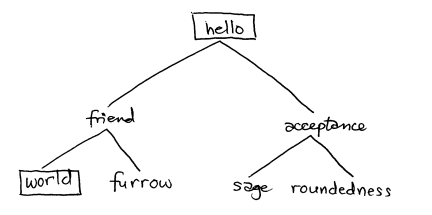
    greeting   = (friend acceptance)
    friend     = (world furrow)
    acceptance = (sage roundedness)

greeting = ((world furrow) (sage roundedness))Put into plain English, a greeting is acceptance of a friend, which is sagacious roundedness toward a furrow in the world.
Note that "greeting" or "hello" is the first term in this KenningHaiku, and "world" is the last (see the kenning tree at the start of this game; these terms are highlighted). Hello, World!
Imagine fondly embracing your dearest friend after a long separation, accepting them with all their faults and foibles. This is greeting.
Imagine a furrow that you have plowed in the night sky, filled with fertile star-stuff, ready to blossom. This is a friend.
Imagine an intelligent sphere, somewhat like Humpty Dumpty, wearing a crown. It is round; it is regal; it is complete, and in its completeness, nothing can disturb it. This is acceptance.
Imagine a regal, intelligent sphere, fondly waiting for the star-stuff it has sown into the sky to blossom, not caring whether the flowers be good or bad. This is greeting.
--Ron_Hale-Evans?
 This wiki is licensed under a Creative Commons Attribution-Share Alike 3.0 License.