![[Home]](https://ludism.org/logo/beads.gif)
GlassPlateGame played at the house of Timothy Higgins in Mill Creek, Washington.
| Move # | Colour | Idea Card | Icon | Status | Player | Comment |
| 1 | orange | struggle | 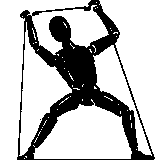 | # (new chain) | Dunbar Aitkens | n/a |
| 2 | orange | joy | 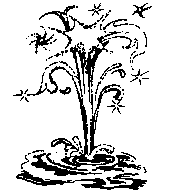 | P (permitted) | Dunbar Aitkens | Sometimes you experience more joy when you achieve something if you had to struggle for it than if you achieved it easily. |
| 3 | orange | metamorphosis | 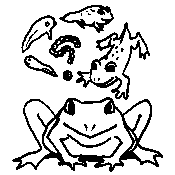 | P (permitted) | Kisa_Griffin? | The process of struggle itself can be worthwhile. |
| 4 | orange | emotional manipulation | 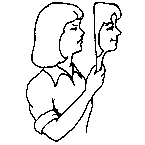 | P (permitted) | ??? | ??? |
| 5 | orange | society as active/passive hierarchy | 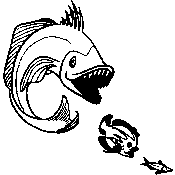 | P (permitted) | Dunbar Aitkens | Once you set a revolution in action, how do you stop the vicious people needed to fight it from taking over afterward? |
| 6 | orange | art vs. nature | 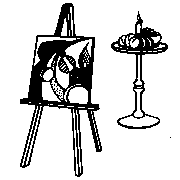 | P (permitted) | Ron_Hale-Evans? | The image one has of the future (of a revolution, or anything else) is an abstraction and often does not match the reality. |
| 7 | orange | need not to judge |  | P (permitted) | Kisa_Griffin? | But- we don't need to judge outcomes so harshly. It may be that whatever happens is good. |
| 8 | orange | syntax | 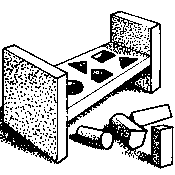 | O (okayed) | ??? | ??? |
| 9 | green | anthropomorphism | 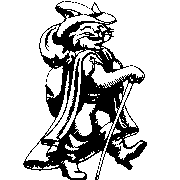 | # (new chain) | Kisa_Griffin? | People project human experiences onto the actions of animals, but we have no way of really knowing if they're thinking what we think they're thinking. |
| 10 | green | ambivalence | 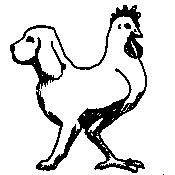 | O (okayed) | ??? | Nonhuman nonverbal language is ambiguous. |
| 11 | green | helplessness | 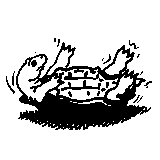 | O (okayed) | Ron_Hale-Evans? | Even though you cannot always know what nonhuman nonverbal language means, there are some near-universals, such as suffering, that you can usually deduce. |
| 12 | green | species specific norms | 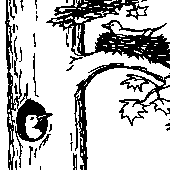 | O (okayed) | LionKimbro | Every animal species has its own nonverbal language. They don't try to mimic each other's ways of doing things. |
| 13 | green | coding |  | O (okayed) | LionKimbro | It is possible to translate (encode) the symbols of the language of one species into the language of another species. |
| 14 | green | syntax | | O (okayed) | LionKimbro | Perhaps there is a universal grammar of non-verbal communications. |
| 15 | green | intuition | 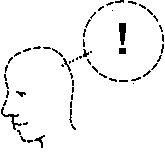 | P (permitted) | ??? | ??? |
| 16 | green | symbolic handles | ??? | P (permitted) | LionKimbro | The conscious thoughts in our heads are symbolic handles that come from thought occuring on an unconscious level. The unconscious processing is the main processing- the conscious thoughts may be more of an after-effect. |
| 17 | green | gestalt | 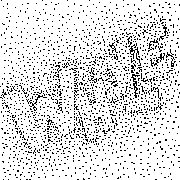 | P (permitted) | ??? | The seperation between the conscious emmanations and the unconscious ("unrepresented") thoughts is likely that "one bleeds over into the other"- on the surface we can distinguish, but looked at in detail, it becomes hard to distinguish. |
| 18 | green | art vs. nature | | P (permitted) | ??? | ??? |
| 19 | red | syntax | | # (new chain) | ??? | n/a |
| 20 | red | hidden potential | 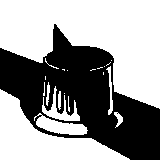 | O (okayed) | Ron_Hale-Evans? | The use of constraints in art (syntax) liberates the hidden potential in an artform. Compare the OuLiPo?. |
| 21 | ??? | freedom | 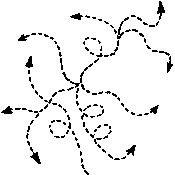 | ??? | Kisa_Griffin? | ??? |
| 22 | red | myth | 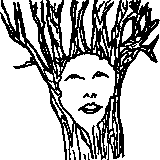 | O (okayed) | LionKimbro | The idea that the realms of experience are a canvas, and that freedom and constrain pop out of that canvas- is a myth. (Maybe true, maybe false, but it's a guiding myth.) |
| 23 | red | nature tending toward perfection | 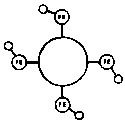 | O (okayed) | Ron_Hale-Evans? | Extending the myth, there is an organising principle that generates order out of disorder and the Universe out of random bits. Compare Permutation City by Greg Egan. |
| 24 | red | recursion | 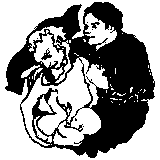 | P (permitted) | John_Braley? | According to the myth discussed, humans create mathematics, and mathematics creates the universe, which contains humans. (The card "return" was used for the concept "recursion" to end the game.) |
According to the photos I took of the board, somewhere in the Orange chain near the beginning of the game, someone played the "emotional manipulation" card:
IIRC, this was between "society as active/passive hierarchy" and "art vs. nature", around Turn 5, but I can't see how to fit it in. Dunbar? Anyone?
Also, the graphic for "symbolic handles" does not seem to be readily available online.
-- Ron_Hale-Evans? [[DateTime?(2004-06-20T09:20:27Z)]]
I just realised there was no Turn 4 listed, and that this was where "emotional manipulation" went. Dunbar, was this Permitted, or Okayed?
 This wiki is licensed under a Creative Commons Attribution-Share Alike 3.0 License.